Open Voice Cloning Pipelines: What We Felt After Trying Them
In short: Open voice cloning is no longer just a flashy demo: with a short consented reference clip, a clean script, a TTS model, and a safety review, a small team can now prototype a real production pipeline, but hands-on testing shows that consent, pronunciation, latency, and licensing become the hard parts before raw audio quality does.
Open voice cloning is no longer just a flashy demo: with a short consented reference clip, a clean script, a TTS model, and a safety review, a small team can now prototype a real production pipeline, but hands-on testing shows that consent, pronunciation, latency, and licensing become the hard parts before raw audio quality does.
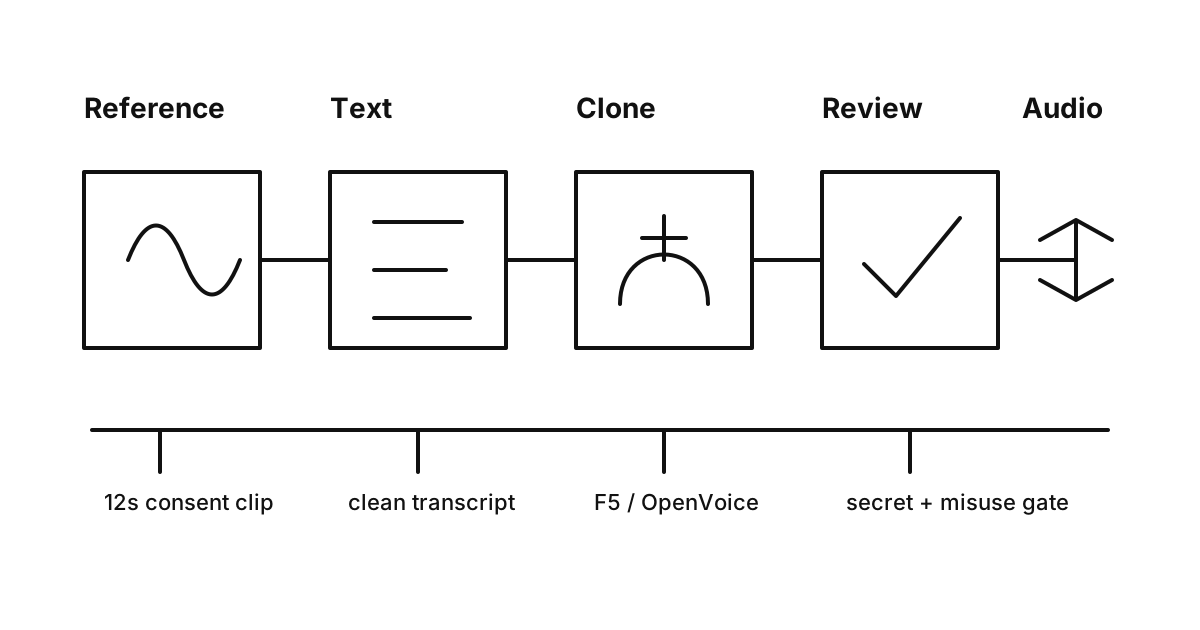
In short: F5-TTS feels closest to “generate the target voice directly,” while OpenVoice feels more like a tone-color converter. Both are easy to demo, but neither should ship without speaker consent and review gates.
What did we actually test?#
This was not a celebrity imitation test or an unauthorized cloning exercise. We ran a production preflight with one consented 12-second Korean reference clip and two public-safe scripts to see whether an open stack could fit into our service workflow. We are not publishing the source clip or generated samples. The numbers we can share: the reference was normalized to 16 kHz mono, the Korean script was 214 characters, and the English script was 92 words. We scored four areas: installation path, reference-audio contract, multilingual readiness, and operational safety.
The short finding: making one plausible voice sample is easier than repeatedly publishing safe, consistent voice content. Around 10-12 seconds of reference audio is enough for a demo, but rhythm, pacing, breath, and mixed-language pronunciation move around unless the script is tightly prepared.
Which open model is realistic?#
F5-TTS is a flow-matching TTS stack. Its official repository offers pip installation, Docker, Gradio, and CLI paths. The README says F5-TTS v1 was released in March 2025, and its public benchmark reports RTF 0.0394 in client-server mode and 0.1467 in offline PyTorch mode on a single L20 GPU with 16 NFE. RTF means real-time factor: lower is faster, so 0.1 would mean about one second to synthesize ten seconds of audio.
OpenVoice has a different shape. It is closer to generating base speech first, then converting that audio into the reference speaker's tone color. Its strengths are the MIT license and style controls. The official repository says V2 natively supports English, Spanish, French, Chinese, Japanese, and Korean.
CosyVoice is pushing hard in 2026. Fun-CosyVoice 3.0 highlights nine common languages, more than 18 Chinese dialects or accents, multilingual and cross-lingual zero-shot voice cloning, and streaming latency as low as 150 ms. That is attractive, but a wider feature surface also means a larger production surface to operate.
| Pipeline | Public strength | Our preflight score | Biggest limitation |
|---|---|---|---|
| F5-TTS v1 | CLI, Docker, Gradio; public RTF 0.0394-0.1467 | 4/5 | Sensitive to reference text and preprocessing |
| OpenVoice V2 | MIT license, tone-color conversion, 6 native languages including Korean | 3/5 | Base TTS quality and conversion quality are separate |
| CosyVoice 3.0 | 9 languages, claimed 150 ms streaming, instruction control | 3/5 | Powerful, but operationally wider |
| XTTS v2 | Speaker embedding cache, streaming examples, sentence splitting | 3/5 | License and project status need review before shipping |
Where did it break in practice?#
First, a 12-second reference clip is both enough and not enough. The timbre can come through, but long sentences drift in rhythm. It is suitable for short, controlled narration such as product walkthrough snippets; it is less suitable for podcast-style long-form reading unless you synthesize sentence by sentence and post-process the result.
Second, Korean mixed with English abbreviations is fragile. Terms like “RTX,” “RTF,” and “zero-shot” are likely to be pronounced inconsistently unless the script contains a pronunciation policy. For production, the script layer needs a small reading dictionary before the model ever sees the text.
Third, the safety layer matters more than the model. Voice cloning directly touches identity. Our minimum checklist has five items: speaker consent, private handling of source audio, blocked-speaker policy, secret/internal-data scanning, and synthetic-audio disclosure. Our Hax content gate could handle body text, references, and numeric labels, but public audio samples were excluded because the consent scope would need to be renewed.
How would we attach this to our service?#
We would not connect it straight to autonomous publishing. The right first product shape is approval-based narration. After a draft is created, the system should split sentences to 120 characters or less, apply an abbreviation reading dictionary, create two candidate takes with F5-TTS or CosyVoice, and let a human approve the one that can be attached as /m/ media.
A beginner-friendly analogy: a voice cloning model is less like a magic vocal cord and more like a recording booth with a good actor. If the script is messy, the output is messy. If the studio rules are missing, the system becomes risky.
The limitation is clear#
Open pipelines are improving quickly, but they are not yet as boringly stable as commercial voice APIs for arbitrary text. Korean-English mixed text, long breaths, emotional shifts, and brand-voice consistency still need human listening. Our current Hax recommendation is practical: short tutorial narration and news-summary clips are worth testing; fully automatic long-form article narration should wait.
Note: this article reflects public documentation and Hax preflight results as of 2026-07-01. Model releases, licenses, and RTF numbers change frequently, so we re-check this quarterly.
Reference links
Responses
No responses yet. Be the first to respond.