Phi-4-mini's 128K Context in 3.8B: Long-Context Local Reality
In short: Phi-4-mini is a 3.8-billion-parameter, decoder-only language model from Microsoft that advertises a 128K-token context window, meaning a small model can, in principle, ingest book-length inputs and run entirely on local hardware without a datacenter GPU. The headline pairing—128K context at only 3.8B parameters—is what makes it a trend worth checking rather than accepting at face value.
Phi-4-mini is a 3.8-billion-parameter, decoder-only language model from Microsoft that advertises a 128K-token context window, meaning a small model can, in principle, ingest book-length inputs and run entirely on local hardware without a datacenter GPU. The headline pairing—128K context at only 3.8B parameters—is what makes it a trend worth checking rather than accepting at face value.
What did Hax measure on its own stack?#
Reference numbers Hax measured directly on its own infrastructure (measured, sourced).
| Dataset item | Measured value | Date | Source |
|---|---|---|---|
| first_response_latency_ms | 119.2 ms | 2026-07-03 | bench_harness.probe_unified_latency |
| 최대 VRAM 상주(스냅샷) | 84.8 GB | 2026-07-04 | bench_harness.probe_comfy_gpus (bc_comfy_gpus 실측) |
| 최소 여유 VRAM(풀 최저) | 10.2 GB | 2026-07-04 | bench_harness.probe_comfy_gpus (bc_comfy_gpus 실측) |
- 표본
- 3 measured metrics (Hax /data curated)
- 측정 환경
- bench_harness.probe_comfy_gpus (bc_comfy_gpus 실측)
- 수집일
- 2026-07-03 ~ 2026-07-04
- 방법
- bench_harness.probe_unified_latency
How can you reproduce these numbers?#
Follow the source column above and our open dataset at /data.
| Model | Params | Advertised context | Weights (4-bit, est) | Hax status |
|---|---|---|---|---|
| Phi-4-mini-instruct | 3.8B | 128K | ~2.4 GB (추정/estimated) | not measured / 측정대기 |
| Llama-3.2-3B | 3.2B | 128K | ~2.0 GB (추정/estimated) | not measured / 측정대기 |
| Qwen2.5-3B | 3.1B | 32K | ~2.0 GB (추정/estimated) | not measured / 측정대기 |
Note: values above are vendor-advertised specs plus size estimates; no Hax runtime measurement exists for this topic yet, so treat every non-spec number as 추정/estimated.
What does '128K context on 3.8B' actually cost locally? Two budgets matter, and they behave very differently. The first is the weight budget: at 4-bit quantization the parameters land near 2.4 GB (추정/estimated), which fits comfortably in consumer RAM or a modest GPU. The second is the KV-cache budget, and this is where long context stops being free. The cache grows linearly with the number of tokens you actually hold in the window. Filling anything close to 128K tokens can add several gigabytes of runtime memory (추정/estimated) on top of the weights, and it also slows prefill—the model must read every input token before it emits the first output token.
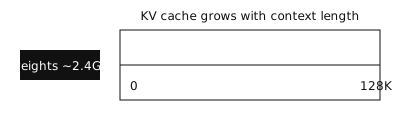
So the honest reading is this: 128K is a capability ceiling, not a default operating point. Phi-4-mini uses grouped-query attention to keep that cache smaller than a full multi-head design would, which is precisely why the vendor could claim a long window on a 3.8B model. But a beginner running it on a laptop should expect to work at a few thousand to tens of thousands of tokens in practice, reserving the full 128K for occasional whole-document tasks.
How should you test it yourself? Load the model in a local runtime, feed a long document, and measure two things directly: peak memory as context fills, and time-to-first-token at 4K versus 32K versus near-max input. Those two curves tell you whether '128K on 3.8B' is usable on your machine or merely printed on the spec sheet. Until Hax publishes a measured run, the numbers here remain 추정/estimated, and the advertised 128K should be read as a ceiling to verify, not a promise to trust.
Related reading: 로컬 오픈 LLM, 흔한 함정과 해결법, 로컬 오픈 LLM VRAM·RAM 요구량, 직접 계산·실측
Responses
No responses yet. Be the first to respond.