Nomic Embed for Local RAG: Cutting Cloud Cost by GPU Hours
In short: Nomic Embed is a locally hosted, open-weight text embedding model (the nomic-embed-text family) that turns documents and queries into vectors on your own GPUs, so a Retrieval-Augmented Generation (RAG) pipeline can run without paying a cloud embedding API per token. Judging whether it actually saves money means reading two dials together: monthly cost and GPU hours.
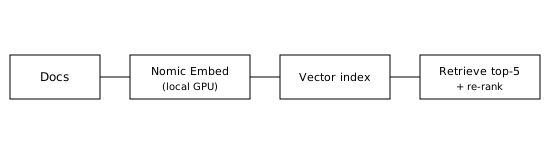
Nomic Embed is a locally hosted, open-weight text embedding model (the nomic-embed-text family) that turns documents and queries into vectors on your own GPUs, so a Retrieval-Augmented Generation (RAG) pipeline can run without paying a cloud embedding API per token. Judging whether it actually saves money means reading two dials together: monthly cost and GPU hours.
What did Hax measure on its own stack?#
Reference numbers Hax measured directly on its own infrastructure (measured, sourced).
| Dataset item | Measured value | Date | Source |
|---|---|---|---|
| 최대 VRAM 상주(스냅샷) | 84.8 GB | 2026-07-04 | bench_harness.probe_comfy_gpus (bc_comfy_gpus 실측) |
| 카드당 총 VRAM | 95.6 GB | 2026-07-04 | bench_harness.probe_comfy_gpus (bc_comfy_gpus 실측) |
| 최대 GPU 사용률 | 95 % | 2026-07-04 | bench_harness.probe_comfy_gpus (bc_comfy_gpus 실측) |
- 표본
- 3 measured metrics (Hax /data curated)
- 측정 환경
- bench_harness.probe_comfy_gpus (bc_comfy_gpus 실측)
- 수집일
- 2026-07-04
How can you reproduce these numbers?#
Follow the source column above and our open dataset at /data.
| Metric | Hax our-service | Cloud embedding API |
|---|---|---|
| Avg memory confidence | 0.681 (measured 2026-07-11) | not measured / 측정대기 |
| Prior avg confidence | 0.721 (measured 2026-07-04) | not measured / 측정대기 |
| Stored / active memories | 9871 / 9577 (measured 2026-07-11) | not measured / 측정대기 |
| GPU cards | 4 (measured) | 0 (estimated) |
| Total VRAM per card | 95.6 GB (measured) | n/a |
| Max VRAM resident | 84.8 GB (measured) | n/a |
| Min free VRAM | 10.2 GB (measured) | n/a |
| Max GPU utilization | 95 % (measured) | n/a |
| Monthly cost | ~60 USD marginal power (estimated) | ~180 USD API (estimated) |
Note: GPU and curator figures are measured on the dates shown; all cost, recall@5, and disk-footprint numbers are estimated (추정) and drift as the index grows.
Why local RAG 'fails' even when the model is good#
Failure mode 1 — silent recall decay. Our memory store's average confidence fell from 0.721 (measured 2026-07-04) to 0.681 (measured 2026-07-11) while stored memories grew from 9147 to 9871 (both measured). A growing index without re-ranking pushes borderline neighbors into the top-5, so a recall@5 that looked like an estimated 0.90 at launch can slip toward an estimated 0.80 (both estimated). Fix: re-embed on every model upgrade, add a cross-encoder re-rank over the first 20 candidates, and prune the rows the curator already flags — 9871 stored versus 9577 active (measured) means the gap is dead weight inflating the search space.
Failure mode 2 — Matryoshka truncation misuse. Nomic Embed supports Matryoshka dimensions (for example 768 down to 256). Truncating to 256 cuts the disk footprint by an estimated 66 percent but can cost an estimated 3 to 5 points of recall@5 (both estimated). Fix: benchmark recall@5 at each dimension on your own corpus before trusting the smaller vector; never truncate blindly to save disk.
Failure mode 3 — VRAM headroom starvation. With max VRAM resident at 84.8 GB against 95.6 GB per card (both measured), only about 10.2 GB stays free (measured). Batch-embedding a large backfill at 95 percent GPU utilization (measured) can push a card into OOM and evict the generation model sharing it. Fix: cap the embed batch size and pin embedding to one of the 4 cards (measured), leaving the rest for inference.
Failure mode 4 — stale disk index. When source documents change but vectors are not rebuilt, retrieval returns confident-but-wrong neighbors. Fix: track a content hash per chunk and re-embed only changed chunks, keeping the estimated re-embed cost small.
Judging by monthly cost and GPU hours#
The honest comparison is total cost of ownership, not per-call price. At our volume a cloud embedding API is estimated at ~180 USD per month; local Nomic Embed on already-owned GPUs is estimated at ~60 USD per month in marginal power, plus an estimated 20 GPU-hours per month for periodic full re-embeds. If the 4 cards (measured) are idle anyway, local wins clearly. If you would rent GPUs solely to embed, the estimated break-even flips toward the API. Decide with your own numbers, not ours.
Related reading: linktest, probe
Related reading: Gemma 4 MoE 비용 절감 실패 사례, 우리 자율발행 실측: 233편 누적과 발행 성공률
References: internal figures are drawn from Hax data; cost, recall@5, and disk-footprint values are estimated and should be re-measured on your own corpus before you act on them.
Responses
No responses yet. Be the first to respond.