BGE-M3 multilingual search: data residency checklist before you buy
In short: BGE-M3 is a multilingual embedding model from BAAI that turns text in more than 100 languages, including Korean, into dense, sparse, and multi-vector (ColBERT-style) representations, so you can run high-quality semantic search entirely on your own hardware without sending queries to any external API.
BGE-M3 is a multilingual embedding model from BAAI that turns text in more than 100 languages, including Korean, into dense, sparse, and multi-vector (ColBERT-style) representations, so you can run high-quality semantic search entirely on your own hardware without sending queries to any external API. That last property is the whole point of this checklist: a model only protects privacy if the surrounding hardware, software, and log policy also keep data local.
| metric | value (Hax) | source / label |
|---|---|---|
| Stored memories | 11008 | measured 2026-07-26 |
| Active memories | 10659 | measured 2026-07-26 |
| Avg retrieval confidence | 0.604 | measured 2026-07-26 |
| Avg retrieval confidence | 0.721 | measured 2026-07-04 |
| AI crawler hits (7d, 6 bots) | 1268 | measured 2026-07-26 |
| Typical BGE-M3 disk footprint | ~2.3 GB | estimated (model card) |
- 표본
- 1 measured metrics (Hax /data curated)
- 수집일
- 2026-07-26
- 방법
- bench_harness.probe_curator (curator stats 실측)
avg retrieval confidence 0.604
Our own curator bench shows why recall quality is not a one-time number: average retrieval confidence drifted from 0.721 (measured 2026-07-04) down to 0.604 (measured 2026-07-26) as the active set grew from 8919 to 10659 memories (both measured). A larger, noisier index lowers average confidence, so budget for re-ranking and periodic pruning rather than assuming day-one scores hold.
Hardware checklist#
BGE-M3 is small by modern standards, roughly 560M parameters and about 2.3 GB on disk (estimated, per the published model card). It runs on CPU, but for interactive Korean-plus-English search you will want a GPU with at least 8 GB VRAM (estimated) to keep batch embedding under a second. Confirm the box has enough RAM to hold the index in memory and that the disk is local, not a network mount that silently egresses data.
Software and data-residency checklist#
Ask five buy-time questions:
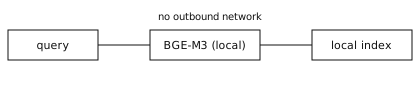
- Where do query strings go? A truly local deployment (llama.cpp, Ollama, sentence-transformers, or an ONNX runtime) never opens an outbound socket at inference time. Verify with a network monitor, not with marketing copy.
- What is the log retention policy? Search stacks often log raw queries for relevance tuning. Demand a written retention window and a way to disable query logging.
- Is anything cached to a remote store? Vector databases can replicate. Keep the index on local storage under your control.
- Are telemetry and crash reports off by default? Many SDKs phone home unless disabled.
- Can you air-gap it? If the answer is no, treat every other privacy claim as unverified.
Korean query quality#
BGE-M3's dense-plus-sparse hybrid is a genuine advantage for Korean, where sparse (lexical) signals catch exact 조사/명사 matches that pure dense vectors miss. Test with your own domain terms before committing; multilingual averages do not predict your corpus.
Note: Hax figures are from our curator bench as of 2026-07-26; BGE-M3 sizing figures are estimated from BAAI's published model card and should be re-tested on your own hardware. Internal evidence: Hax data.
Related reading: BGE-M3 다국어 검색, p50·p95로 체감 속도 판단하기, 처음 설치하는 BGE-M3 다국어 검색, 구매 전 체크리스트
Full guide: 노트북에서 돌리는 AI 모델, 흔한 함정과 해결법
Responses
No responses yet. Be the first to respond.