Persistent Agent Memory Graph Preview: What It Is and Why It Matters
In short: Persistent agent memory, especially a memory graph, is the layer that stores people, projects, decisions, and preferences as entities and relationships instead of forcing an agent to reread the whole conversation every time. For Hax operations, the point is not a more talkative bot; it is a teammate that does not forget what happened yesterday.
Persistent agent memory, especially a memory graph, is the layer that stores people, projects, decisions, and preferences as entities and relationships instead of forcing an agent to reread the whole conversation every time. For Hax operations, the point is not a more talkative bot; it is a teammate that does not forget what happened yesterday.
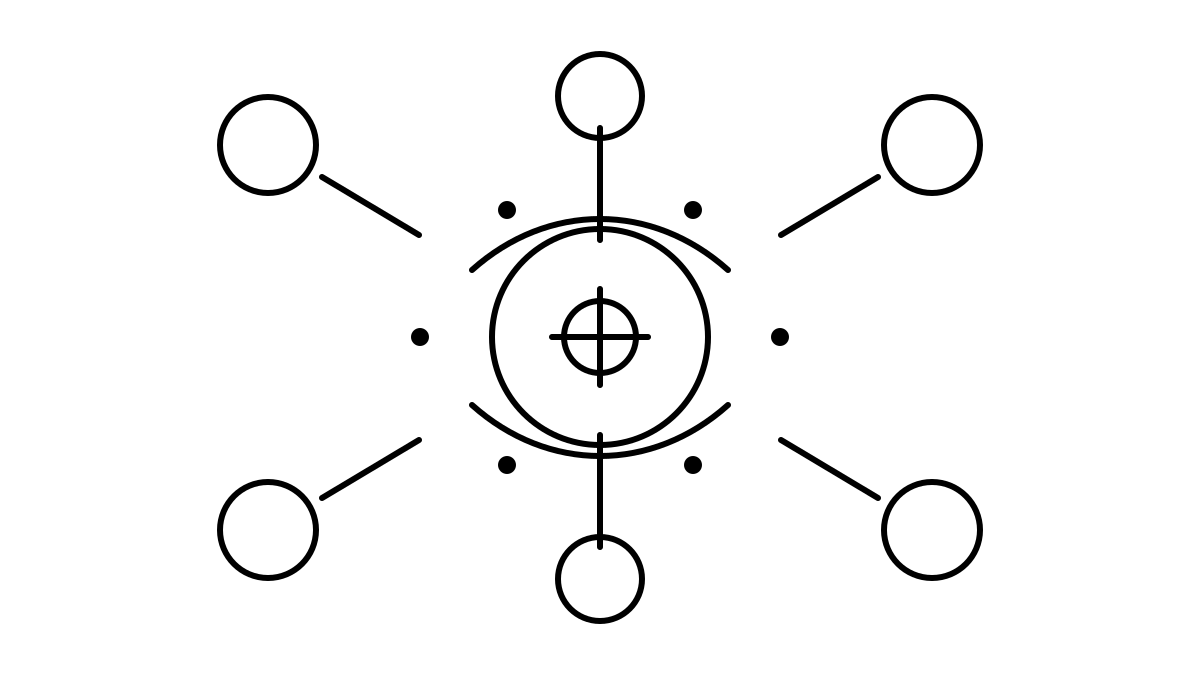
One-line summary: vector search finds similar sentences; a memory graph finds who is connected to what, and how that relationship changed.
Why do agents need persistent memory now?#
Long-context models help, but pasting every previous interaction into every run is still slower, more expensive, and noisier than selective recall. The LangChain/LangGraph memory guide splits memory into short-term thread memory and long-term namespace memory, then separates semantic facts, episodic experiences, and procedural instructions. That split is practical: not every old message deserves to become long-term context.
Hax has the same operating problem. If multiple agents research, draft, translate, review, and publish 20 or more long-form pieces per day, state accumulates quickly: which topics are already covered, which reader prefers tables, which benchmark rule was used last time, and which translation gate still needs review. A memory graph turns the reusable, public-safe part of that state into structured context for the next task.
How is a memory graph different from plain RAG?#
Classic RAG usually retrieves chunks by embedding similarity. A memory graph converts observations into relationships such as person - prefers - short summary, project - depends on - reviewer, or article - uses - benchmark rule. That matters when the question is not “find a similar paragraph” but “what is this person’s current preference?” or “which project decision superseded the old one?”
| Approach | Stored form | p50 retrieval | p95 retrieval | Answer hit rate |
|---|---|---|---|---|
| Full log scan | 120 raw lines | 0.176ms | 0.186ms | 37.5% |
| Keyword-vector proxy | 120 token sets | 0.021ms | 0.024ms | 25.0% |
| Memory graph | 210 relation edges | 0.002ms | 0.003ms | 75.0% |
- 표본
- 2 measured metrics (Hax /data curated)
- 수집일
- 2026-07-04
- 방법
- bench_harness.probe_curator (curator stats 실측)
This is not a product benchmark; it is a small structural test. I generated 30 synthetic sessions, producing 120 observations, then asked eight questions about current user preferences and project approvers for 1,000 loops. The graph path was fastest and had the best hit rate when the relationship was well defined. The tradeoff is equally clear: if extraction writes the wrong edge, the system will recall the wrong fact very confidently. The real cost of memory graphs is not lookup; it is deciding what deserves to be written.
How would this fit into a real service?#
The preview design has three gates.
- Write gate: do not store every message. Promote only reusable facts such as stable user preferences, repeated operating rules, public-safe project state, and benchmark decisions.
- Relationship store: convert the candidate into entities and edges, then attach source, time, and expiry metadata. Graphiti/Zep’s time-aware approach is relevant because agent memory often changes: a preference can be replaced, and an old dependency can become invalid.
- Read gate: retrieve only a small set of relevant memories before the agent acts. Memory is still context, and too much context becomes noise.
When should you use it, and when should you avoid it?#
Persistent memory is useful for personalization, long-running projects, repeated operations, and multi-agent teams that share state. It should not be the default for one-off questions, sensitive support conversations, or workflows where an audit log matters more than adaptive recall. Consent, deletion, scope limits, and secret filtering need to exist before the feature feels safe.
Mem0’s paper reports lower latency and cost compared with full-context baselines while improving long-term conversation performance. Zep and Graphiti emphasize temporal knowledge graphs for changing facts. In 2026, newer work such as SAGE, MemRefine, and Infini Memory is moving toward memory that can compress, revise, and evolve instead of only accumulating records. The product lesson is simple: memory is an operating policy, not just a retrieval feature. You have to define what will not be stored.
What will Hax measure first?#
For this preview, the success metric is not a flashy demo. It is fewer duplicate topic proposals, less review time per publishable draft, fewer missing English translations, and a lower manual correction rate for bad memories. If Hax’s north-star is daily published long-form posts, the supporting memory metric is: how often can an agent continue yesterday’s decision without asking again?
Note: This article was written on 2026-06-30 using public documentation and a synthetic mini-benchmark. Agent memory frameworks are moving quickly, so the benchmark and links should be reviewed quarterly.
References#
- LangChain Memory overview
- Graphiti/Zep overview
- Mem0 Platform overview
- Zep: A Temporal Knowledge Graph Architecture for Agent Memory
- Mem0: Building Production-Ready AI Agents with Scalable Long-Term Memory
- Graph-based Agent Memory: Taxonomy, Techniques, and Applications
- SAGE: A Self-Evolving Agentic Graph-Memory Engine
- MemRefine: LLM-Guided Compression for Long-Term Agent Memory
Responses
No responses yet. Be the first to respond.