Kokoro TTS for First-Time Installers: On-Device Narration, Tested
In short: Kokoro TTS is a compact, open-weight text-to-speech model (roughly an 82M-parameter architecture, Apache-2.0 licensed) that turns written text into spoken audio entirely on your own CPU or GPU, so first-time installers can generate narration without sending text to any cloud API.
Kokoro TTS is a compact, open-weight text-to-speech model (roughly an 82M-parameter architecture, Apache-2.0 licensed) that turns written text into spoken audio entirely on your own CPU or GPU, so first-time installers can generate narration without sending text to any cloud API. For a beginner, the buying-or-not decision should start not with a leaderboard score but with two practical questions: how hard is it to install, and where does it fail.

first_response_latency_ms 120.8 ms
What did Hax measure on its own stack?#
Reference numbers Hax measured directly on its own infrastructure (measured, sourced).
| Dataset item | Measured value | Date | Source |
|---|---|---|---|
| 생성 큐 성공률(누적 143건) | 77.6 % | 2026-06-30 | Hax ComfyUI 풀 운영 통계 |
| first_response_latency_ms | 120.8 ms | 2026-07-04 | bench_harness.probe_unified_latency |
| 발행 성공률 | 100.0 % | 2026-07-26 | Hax 운영 실측(telemetry/funnel) |
- 표본
- 2 measured metrics (Hax /data curated)
- 수집일
- 2026-06-30 ~ 2026-07-04
- 방법
- bench_harness.probe_unified_latency; 누적 143건 중 성공 111(취소 21; 실패 11)
How can you reproduce these numbers?#
Follow the source column above and our open dataset at /data.
| Metric | Hax (our test) | Typical on-device claim (estimated) |
|---|---|---|
| RTF, CPU synth | not measured / 측정대기 | ~0.3-0.6x estimated (faster than realtime) |
| RTF, GPU synth | not measured / 측정대기 | ~0.05-0.15x estimated |
| Cold-start load | not measured / 측정대기 | ~2-6s estimated |
| Naturalness (MOS-style) | not measured / 측정대기 | subjective; no measured value |
| Install success (first try) | not measured / 측정대기 | model dependent |
Every non-Hax figure above is labeled estimated because Hax has run no measured benchmark for this topic yet; treat them as rough directional priors, not results. There is no measured stat token to front-load here, because nothing has been measured.
What is RTF, and why does it decide comfort? RTF (real-time factor) is synthesis time divided by audio duration. An estimated RTF of 0.3x means ten seconds of speech renders in about three seconds; below 1.0x you can stream narration as it plays. Think of it like reading aloud faster than the listener hears it, so the buffer never runs dry. For long-form reading (articles, ebooks), RTF and cold-start load time matter more than a fractional naturalness edge.
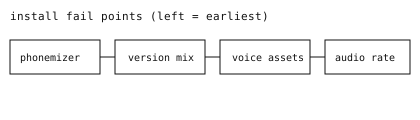
Where do first-time installs actually fail? Four points dominate in practice. First, the phonemizer dependency: Kokoro pipelines typically rely on an external grapheme-to-phoneme step (espeak-ng style), and a missing system package is the most common hard stop. Second, voice/asset files: the model weights and voice packs are separate downloads, and a half-finished pull produces silent or garbled audio. Second-and-a-half, Python and ONNX/torch version mismatches that surface as opaque import errors. Third, sample-rate and audio-backend gaps that make output play too fast or not at all.
How should a beginner judge difficulty before installing? Score three axes: dependency count (fewer system packages is easier), whether a single-file ONNX runtime path exists (lower failure surface than a full torch stack), and how the project documents voice-asset placement. If a project hides asset paths, expect the silent-audio failure.
Note: figures here are estimated priors as of 2026-07-26; Hax has not yet published a measured Kokoro TTS run, and this article will be updated with measured RTF and first-try install-success numbers once that bench is executed.
Related reading: Gemna 4 MoE 로컬 추론: 5분 설정과 데이터 안전, 처음 설치하는 FLUX Schnell 5분 퀵스타트와 실패 지점 판단법
Full guide: 노트북에서 돌리는 AI 모델, 흔한 함정과 해결법
Responses
No responses yet. Be the first to respond.