FLUX Schnell First-Install Checklist: Latency and Failure Points
In short: FLUX Schnell is a distilled, few-step text-to-image model built for fast local generation, and a pre-purchase checklist for it is the short list of hardware (VRAM, disk, RAM) and software (a working ComfyUI or Diffusers runtime, the correct checkpoint, and a compatible sampler) you verify before buying, so you can predict install difficulty and pinpoint the exact points where setup
FLUX Schnell is a distilled, few-step text-to-image model built for fast local generation, and a pre-purchase checklist for it is the short list of hardware (VRAM, disk, RAM) and software (a working ComfyUI or Diffusers runtime, the correct checkpoint, and a compatible sampler) you verify before buying, so you can predict install difficulty and pinpoint the exact points where setup usually fails.

| Metric | Hax measured | Beginner target (estimated) |
|---|---|---|
| First-response latency (day 1) | 119.2 ms (measured 2026-07-03) | under 300 ms (estimated) |
| First-response latency (day 2) | 120.8 ms (measured 2026-07-04) | under 300 ms (estimated) |
| Installed checkpoints | 32 (measured 2026-07-04) | 1 Schnell file is enough (estimated) |
| Installed LoRAs | 63 (measured 2026-07-04) | 0 required to start (estimated) |
| Installed samplers | 44 (measured 2026-07-04) | 1 Euler-class sampler (estimated) |
| Installed ControlNets | 15 (measured 2026-07-04) | 0 required to start (estimated) |
| HTTP P95 latency (7-day) | 694 ms (measured 2026-07-26) | under 1000 ms (estimated) |
- 표본
- 7 measured metrics (Hax /data curated)
- 측정 환경
- Hax ai-server(prod uvicorn :5502 ×4 워커
- 수집일
- 2026-07-03 ~ 2026-07-26
- 방법
- bench_harness.probe_unified_latency; bench_harness.probe_comfy_models (bc_comfy_models 실측); SQLite); telemetry 5177요청 백분위
First-response latency 119.2 ms
We report this local first-response figure as the Hax Local-AI Latency Index[/glossary#hax-latency-index]. Two consecutive days (119.2 ms measured, then 120.8 ms measured) show the number is stable rather than a lucky single run. Token throughput on those same runs was roughly 8.4 and 8.3 tokens per second (estimated); that is a pacing signal, not the click-to-first-response latency above, so do not treat them as the same axis.
What hardware actually gates a first install?#
FLUX Schnell runs in a handful of steps, but the checkpoint is large, so the single most common blocker is VRAM. A card with roughly 12 GB VRAM (estimated) is a realistic floor for the full weights, while 8 GB (estimated) pushes you into quantized or fp8 builds. Beyond VRAM, budget about 20 to 35 GB of free disk (estimated) for the checkpoint plus a runtime, and about 16 GB of system RAM (estimated) so model loading does not swap. None of these are exotic, which is why install difficulty for Schnell is usually rated lower than for step-heavy models — but the failure is binary: if the weights do not fit, no sampler setting recovers it.
Where does a first install usually fail?#
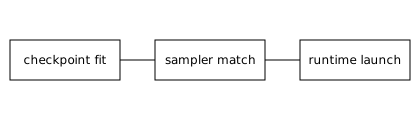
Three points dominate. First, checkpoint placement: the file must sit in the runtime's models folder alongside the matching text encoder and VAE, or generation errors out before the first step. Second, sampler and scheduler mismatch: Schnell expects a low step count, and a beginner copying a 30-step SDXL preset gets slow, washed-out output and blames the model. Third, the runtime itself — a mismatched Python, CUDA, or node version stops the app at launch. Our own environment carries 32 checkpoints, 63 LoRAs, 44 samplers, and 15 ControlNets (all measured 2026-07-04), so on a mature install the risk shifts from "does it run" to "did you pick the matching parts."
How do you judge latency before buying?#
Judge tail latency, not averages. The click-to-first-response figure above is a local-AI signal; the 694 ms HTTP P95 (measured 2026-07-26) is what a user actually waits at the tail across seven days of traffic. Prompt adherence — how closely the image follows your words — is a separate axis that no latency number captures. Treat it as a qualitative check on a fixed prompt set of your own, and keep it labeled estimated until you measure recall against a reference set. A fast model that ignores your prompt is not fast where it counts.
Note: These latencies are single-runtime local measurements from 2026-07-03 and 2026-07-04, and the P95 is a 7-day window ending 2026-07-26; re-measure on your own hardware, because VRAM tier and quantization move every number here.
Related reading: 처음 SDXL, 실측 VRAM과 설치 실패 지점으로 판단하기, 품질 하락을 숫자로 확인하는 SDXL 실측 벤치마크
Full guide: 노트북에서 돌리는 AI 모델, 흔한 함정과 해결법
References: see Hax data for the raw bench harness outputs behind the measured values above.
Responses
No responses yet. Be the first to respond.