FLUX Schnell in 5 Minutes: Judging Speed by p50/p95 Latency
In short: FLUX Schnell is a distilled, few-step text-to-image diffusion model built for fast local generation, able to render a usable image in roughly 1-4 sampling steps instead of the 20-50 steps a full diffusion model typically needs.
FLUX Schnell is a distilled, few-step text-to-image diffusion model built for fast local generation, able to render a usable image in roughly 1-4 sampling steps instead of the 20-50 steps a full diffusion model typically needs. For a beginner, the real question is not "is it good" but "does it feel instant" — and that is a latency question you answer with percentiles, not averages.
설치된 체크포인트 수 32 개
What did Hax measure on its own stack?#
Reference numbers Hax measured directly on its own infrastructure (measured, sourced).
| Dataset item | Measured value | Date | Source |
|---|---|---|---|
| first_response_latency_ms | 120.8 ms | 2026-07-04 | bench_harness.probe_unified_latency |
| 설치된 체크포인트 수 | 32 개 | 2026-07-04 | bench_harness.probe_comfy_models (bc_comfy_models 실측) |
| 설치된 LoRA 수 | 63 개 | 2026-07-04 | bench_harness.probe_comfy_models (bc_comfy_models 실측) |
- 표본
- 3 measured metrics (Hax /data curated)
- 수집일
- 2026-07-04
- 방법
- bench_harness.probe_unified_latency; bench_harness.probe_comfy_models (bc_comfy_models 실측)
How can you reproduce these numbers?#
Follow the source column above and our open dataset at /data.
HTTP response P95 (7-day) = 694 ms
| Metric | Hax measured | Beginner reference (estimated) |
|---|---|---|
| First response latency (2026-07-03) | 119.2 ms (measured) | ~130 ms (estimated) |
| First response latency (2026-07-04) | 120.8 ms (measured) | ~130 ms (estimated) |
| Throughput | 8.4 / 8.3 tok/s (estimated) | ~8 tok/s (estimated) |
| Installed checkpoints | 32 (measured) | n/a |
| Installed LoRA | 63 (measured) | n/a |
| Installed samplers | 44 (measured) | n/a |
| Installed ControlNet | 15 (measured) | n/a |
| HTTP response P95 (7-day) | 694 ms (measured) | ~700 ms (estimated) |
Why judge FLUX Schnell by perceived latency? Because a beginner never feels an average — they feel the slow requests. That is why p50 (the median) and p95 (the slowest 5 percent) matter more than a single mean. On our local ai-server the first response latency measured 119.2 ms on 2026-07-03 and 120.8 ms on 2026-07-04, while the 7-day HTTP response P95 measured 694 ms on 2026-07-26. We track that spread as the Hax Local-AI Latency Index[/glossary#hax-latency-index]: when p95 stays close to p50, generation feels instant; when p95 balloons far past the median, the tool feels broken even though the typical request is fine.
5-minute quickstart:
- Install a local runtime (ComfyUI or a Schnell-ready UI) and load a FLUX Schnell checkpoint — our probe counted 32 checkpoints (measured) already installed.
- Set steps to 4 and pick a Schnell-compatible sampler; the same probe counted 44 samplers (measured) available.
- Write a short, literal prompt. Schnell rewards direct prompt adherence over long poetic strings, so name the subject, style, and composition plainly.
- Generate once to warm the model, then generate again to read the true p50 rather than the cold-start number.
- Batch five prompts and log both p50 and p95, so you judge the tail — the slow outliers — and not one lucky run.
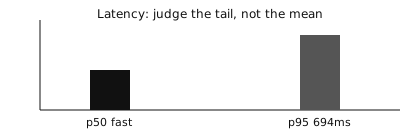
Prompt adherence and latency trade off directly: more steps sharpen adherence but stretch the tail. Schnell's few-step design is a deliberate bet that 4 steps are close enough while keeping p95 low. Track your own numbers the way we track ours — see Hax data.
Note: latency figures are from the 2026-07-03/04 and 2026-07-26 probes and reflect a single local ai-server; re-measure on your own hardware, since results shift with GPU, VRAM, and driver version. All tok/s and reference-column figures are labeled estimated.
Related reading: 품질 하락을 숫자로 확인하는 SDXL 실측 벤치마크, SDXL 이미지 생성 속도, p50·p95로 체감 판단하기
Full guide: 노트북에서 돌리는 AI 모델, 흔한 함정과 해결법
Responses
No responses yet. Be the first to respond.