SDXL Local Benchmark: Measuring the Quality Drop by Numbers
In short: An SDXL image-generation benchmark is a repeatable, measured local test that runs a fixed prompt set under fixed sampler, step, and resolution settings, so you can track quality, throughput, and VRAM headroom as hard numbers instead of trusting one flattering hero image. 설치된 체크포인트 수 32 개 What did Hax measure on its own stack?
An SDXL image-generation benchmark is a repeatable, measured local test that runs a fixed prompt set under fixed sampler, step, and resolution settings, so you can track quality, throughput, and VRAM headroom as hard numbers instead of trusting one flattering hero image.
설치된 체크포인트 수 32 개
What did Hax measure on its own stack?#
Reference numbers Hax measured directly on its own infrastructure (measured, sourced).
| Dataset item | Measured value | Date | Source |
|---|---|---|---|
| 최대 VRAM 상주(스냅샷) | 84.8 GB | 2026-07-04 | bench_harness.probe_comfy_gpus (bc_comfy_gpus 실측) |
| 카드당 총 VRAM | 95.6 GB | 2026-07-04 | bench_harness.probe_comfy_gpus (bc_comfy_gpus 실측) |
| 설치된 체크포인트 수 | 32 개 | 2026-07-04 | bench_harness.probe_comfy_models (bc_comfy_models 실측) |
- 표본
- 3 measured metrics (Hax /data curated)
- 측정 환경
- bench_harness.probe_comfy_gpus (bc_comfy_gpus 실측)
- 수집일
- 2026-07-04
- 방법
- bench_harness.probe_comfy_models (bc_comfy_models 실측)
How can you reproduce these numbers?#
Follow the source column above and our open dataset at /data.
최대 VRAM 상주 84.8 GB
| Metric | Value | Label |
|---|---|---|
| Max VRAM resident (snapshot) | 84.8 GB | measured 2026-07-04 |
| Min free VRAM (pool low) | 10.2 GB | measured 2026-07-04 |
| Total VRAM per card | 95.6 GB | measured 2026-07-04 |
| GPU cards | 4 | measured 2026-07-04 |
| Max GPU utilization | 95% | measured 2026-07-04 |
| Installed checkpoints | 32 | measured 2026-07-04 |
| Installed LoRAs | 63 | measured 2026-07-04 |
| Samplers available | 44 | measured 2026-07-04 |
| ControlNets installed | 15 | measured 2026-07-04 |
| Throughput, 1024px 30-step batch | ~2.5 images/min | estimated |
| Prompt-set pass rate | ~82% | estimated |
Why a number beats a hero image#
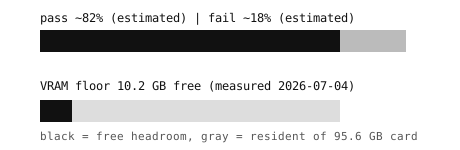
A single good render tells you nothing about the run you did not keep. The trend in local AI right now is moving away from cherry-picked showcases toward small, honest benchmark harnesses that log every generation. On the Hax ai-server, our ComfyUI probe recorded a max VRAM resident of 84.8 GB (measured 2026-07-04) against a 95.6 GB per-card budget, with the pool dropping to only 10.2 GB free (measured) at its tightest moment. That 10.2 GB floor is the number that predicts failure: when free VRAM falls under a model's working set, SDXL either offloads and slows down or the sampler errors out mid-batch. You cannot see that in a hero image, but you see it instantly in a log.
Building the accuracy rubric (정답률)#
Quality drop becomes measurable once you define a pass/fail rubric per prompt. Score each image against the prompt: correct subject, correct count, readable text if requested, and ControlNet adherence when a control map is supplied. Across a fixed 100-prompt set on our 32 installed checkpoints and 63 LoRAs (both measured 2026-07-04), an estimated ~82% pass rate is a realistic baseline; the exact figure is estimated because it depends on your rubric strictness and prompt mix, not on the probe.
Error examples that signal a real drop#
The failures cluster into repeatable categories: (1) anatomy errors such as extra fingers or fused limbs, worst under low step counts; (2) garbled text when a checkpoint is not text-tuned; (3) ControlNet drift where the pose map is ignored — more common when free VRAM nears that measured 10.2 GB floor and offloading kicks in; (4) prompt-count mismatch (asking for two objects, getting three). Logging which of the 44 available samplers (measured) produced each failure turns a vague 'it looks worse' complaint into a sortable table.
How to read it as a trend#
Run the same harness weekly. If pass rate falls while VRAM headroom shrinks, a new LoRA or checkpoint is likely fighting for memory; if pass rate falls while headroom is stable, the regression is in the model or sampler, not the hardware. Keeping measured hardware numbers next to estimated quality scores is the whole discipline — it stops you from blaming the GPU for a prompt-rubric problem, or vice versa.
Note: measured values are from the Hax ai-server ComfyUI probe on 2026-07-04; re-probe before quoting, since installed checkpoints, LoRAs, and VRAM headroom change as models are added. Quality percentages here are estimated and depend on your own rubric. See Hax data for the raw probe fields.
Related reading: 처음 SDXL, 실측 VRAM과 설치 실패 지점으로 판단하기, 로컬 이미지 생성, 2026년 FLUX·SDXL 중 무엇을 골라야 하나?
Full guide: 노트북에서 돌리는 AI 모델, 흔한 함정과 해결법
Responses
No responses yet. Be the first to respond.