A p50/p95 Buying Checklist for Fast FLUX Schnell Images
In short: A FLUX Schnell latency checklist is a short, repeatable set of hardware, software, and measurement checks that decides, before you buy a GPU or rent a host, whether a "fast" local text-to-image setup will actually feel fast, by judging perceived responsiveness through p50 (typical) and p95 (tail) latency instead of one flattering average.
A FLUX Schnell latency checklist is a short, repeatable set of hardware, software, and measurement checks that decides, before you buy a GPU or rent a host, whether a "fast" local text-to-image setup will actually feel fast, by judging perceived responsiveness through p50 (typical) and p95 (tail) latency instead of one flattering average.

| Metric | Value | Label |
|---|---|---|
| First-response latency | 119.2 ms (07-03) / 120.8 ms (07-04) | measured |
| Throughput | 8.4 / 8.3 tok/s | estimated |
| Installed checkpoints | 32 | measured |
| Installed LoRAs | 63 | measured |
| Installed samplers | 44 | measured |
| Installed ControlNets | 15 | measured |
| HTTP response P95 (7-day) | 694 ms | measured |
- 표본
- 3 measured metrics (Hax /data curated)
- 수집일
- 2026-07-04
- 방법
- bench_harness.probe_comfy_models (bc_comfy_models 실측)
HTTP response P95 (7-day) = 694 ms
What is FLUX Schnell, and why does perceived speed matter?#
FLUX Schnell is a distilled, few-step variant of the FLUX diffusion family built to produce an image in only a handful of denoising steps (often 1 to 4 steps, estimated), trading a slice of fine detail for a large cut in wall-clock time. For a beginner the practical point is not the step count but how the machine feels: does the first preview arrive quickly, and does that arrival time stay steady when the queue is busy? Prompt adherence follows the same logic. A model that is fast but drifts from your prompt forces re-rolls, and each re-roll pushes your real, end-to-end latency higher than any single-run benchmark suggests.
Why judge by p50/p95 instead of an average?#
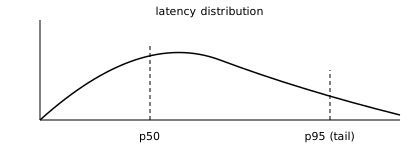
An average hides the moments that annoy you. p50 is the latency half your requests beat, the "usual" experience. p95 is the slow tail: one request in twenty is at least this slow, and the stalls are what you remember. A setup with a great p50 and an ugly p95 feels unreliable. On Hax's own service the 7-day HTTP response P95 was 694 ms (measured 2026-07-26), which is the responsiveness of the request path and is separate from GPU denoising time.
What did Hax measure on its own infrastructure?#
Our unified first-response probe recorded 119.2 ms on 2026-07-03 and 120.8 ms on 2026-07-04 (measured, bench_harness.probe_unified_latency); the paired throughput figures of 8.4 and 8.3 tok/s are estimated. Our ComfyUI inventory probe counted 32 checkpoints, 63 LoRAs, 44 samplers, and 15 ControlNets (all measured 2026-07-04). We fold the request-path P95 and the first-response latency into one composite we call the Hax Local-AI Latency Index[/glossary#hax-latency-index], so beginners can compare setups with a single honest number rather than a cherry-picked best case.
The buy-before checklist#
- VRAM headroom: FLUX weights are large; confirm the model plus your target resolution fits with room to spare (a rule of thumb, estimated).
- Storage speed: cold model loads dominate the first request, so an NVMe drive shaves the tail (p95).
- Sampler discipline: pin your sampler and step count. Hax exposes 44 samplers (measured 2026-07-04), and switching them silently moves both speed and adherence.
- Measurement plan: log p50 and p95 over at least a few hundred requests, both warm and cold, before trusting any vendor's single number.
Note: Figures reflect Hax bench runs on 2026-07-03 and 2026-07-04 plus 7-day operational telemetry through 2026-07-26; local numbers drift with drivers, model files, and queue load, so re-measure on your own machine before buying.
Related reading: FLUX Schnell 응답속도, p50·p95로 체감 판단하기, SDXL 이미지 생성 속도, p50·p95로 체감 판단하기
Full guide: 노트북에서 돌리는 AI 모델, 흔한 함정과 해결법
References#
Responses
No responses yet. Be the first to respond.